Thursday, August 6, 2015

August 6th

Today is August 6th.

Under the hot August sun and painfully blue August sky, I had a day full of regular tasks and fun moments and unremarkable concerns.

But on this day in 1945 the hot sun and painfully blue sky cracked open over Hiroshima, Japan...and then again over Nagasaki, Japan.

And Death came down.

I'm not going to engage in arguments about World War II politics and ethics.  I'm not writing this to insult, nor am I writing this to provoke.  I am not writing this to hold up the horror of one  moment in history  as worse or better than the horror of so many other moments in human history.

I'm writing this so that we remember.


I've visited Hiroshima.  I've gone to the Peace Museum where the flash-shadow of a disintegrated human body was still visible on a brick wall.

I saw the melted bento boxes, the shattered fragments of lives.

And I saw the impossible photos.  And I read the bewildered first-hand accounts.

The vibrant, modern city outside the Peace Museum seemed to throw the gently lit remnants of horror into even greater focus.

The museum asked for one thing:  peace.

And so I post this for one reason:  peace.

And I share this poem for one reason:  peace.

As much as I love weaving words, Maya Angelou reflects my feelings best.
And so I shall let her speak for me.


A Brave and Startling Truth
We, this people, on a small and lonely planet
Traveling through casual space
Past aloof stars, across the way of indifferent suns
To a destination where all signs tell us
It is possible and imperative that we learn
A brave and startling truth

And when we come to it
To the day of peacemaking
When we release our fingers
From fists of hostility
And allow the pure air to cool our palms

When we come to it
When the curtain falls on the minstrel show of hate
And faces sooted with scorn are scrubbed clean
When battlefields and coliseum
No longer rake our unique and particular sons and daughters
Up with the bruised and bloody grass
To lie in identical plots in foreign soil

When the rapacious storming of the churches
The screaming racket in the temples have ceased
When the pennants are waving gaily
When the banners of the world tremble
Stoutly in the good, clean breeze

When we come to it
When we let the rifles fall from our shoulders
And children dress their dolls in flags of truce
When land mines of death have been removed
And the aged can walk into evenings of peace
When religious ritual is not perfumed
By the incense of burning flesh
And childhood dreams are not kicked awake
By nightmares of abuse

When we come to it
Then we will confess that not the Pyramids
With their stones set in mysterious perfection
Nor the Gardens of Babylon
Hanging as eternal beauty
In our collective memory
Not the Grand Canyon
Kindled into delicious color
By Western sunsets

Nor the Danube, flowing its blue soul into Europe
Not the sacred peak of Mount Fuji
Stretching to the Rising Sun
Neither Father Amazon nor Mother Mississippi who, without favor,
Nurture all creatures in the depths and on the shores
These are not the only wonders of the world

When we come to it
We, this people, on this minuscule and kithless globe
Who reach daily for the bomb, the blade and the dagger
Yet who petition in the dark for tokens of peace
We, this people on this mote of matter
In whose mouths abide cankerous words
Which challenge our very existence
Yet out of those same mouths
Come songs of such exquisite sweetness
That the heart falters in its labor
And the body is quieted into awe

We, this people, on this small and drifting planet
Whose hands can strike with such abandon
That in a twinkling, life is sapped from the living
Yet those same hands can touch with such healing, irresistible tenderness
That the haughty neck is happy to bow
And the proud back is glad to bend
Out of such chaos, of such contradiction
We learn that we are neither devils nor divines

When we come to it
We, this people, on this wayward, floating body
Created on this earth, of this earth
Have the power to fashion for this earth
A climate where every man and every woman
Can live freely without sanctimonious piety
Without crippling fear

When we come to it
We must confess that we are the possible
We are the miraculous, the true wonder of this world
That is when, and only when
We come to it. 


Saturday, July 25, 2015

Skin

I have been painting a chair lately.

Here in our echoey new apartment in Glen Ellyn, Illinois,  I have been trying to slowly-like-an-exhasuted-snail-slowly find used furniture that either strikes me as particularly quirky, particularly useful or at least particularly inexpensive.

So I have been painting a $5 wooden chair.

And on top of the paint I have been writing my favorite quotes.

On the seat I have painted a picture of a certain coral sand beach that is at this moment  further from me than it has ever been before.

Why paint that beach?  Because I knew that sometimes I might feel the need to sit on that beach, and since I cannot literally sit on that beach, I can at least figuratively sit on that beach.

And as I was painting this beloved beach onto the seat of this $5 chair, I inevitably got paint on my hands.

I put the lids on my pain bottles and went to the kitchen sink to wash my hands.
Under the cool water and lavender-scented soap, the paint came off easily, peeling out from beneath my finger nails and sloughing off my knuckles.

And I realized just how spectacular and wondrous our skin is.

Our skin keeps our insides from being outsides.  It encapsulates everything we are.  It renews itself daily, but does so in microscopic bits so that we don't feel the loss.   Our skin resists stains, is waterproof and can be easily cleansed of most messes and aromas that would taint other materials.  For most of us our skin resists damage and heals itself when it is cut or torn.  When we are hot our skin sweats us cool; when we are cold our skin shivers us warm.  Our skin endeavors, through its very cells, to protect us from the rays of the sun, the moisture of the rain and the icy pelt of snow.

And it is beautiful.  Our skin comes in an array of rich, lovely colors.  Our skin adapts to our efforts to adorn it, allowing us to turn it into even more of a work of art than it already is as we pierce or  tattoo, henna or self-tan, inject or otherwise alter ourselves into our current identities.  And over time, our skin becomes the parchment upon which  our life is written, each wrinkle and scar part of the story that is us.

Skin is something we all have.  The cells that make up our skin twin with the cells that make up the skin of each person on this earth.

And yet.

It is this same wondrous material--this skin we wear all our lives--that still, STILL inspires hate and mistrust as those ignorant of the power of our skin use it as a weapon.

As the last rubbery bits of paint washed from my hands I marveled how very much alike my skin was to any work of art--the beautiful raw materials at the start slowly, painstakingly transformed into beauty.    And just as easily defaced and destroyed.


Friday, January 2, 2015

A Letter to This Year

Dear 2015,

I've only known you for three days, and since we are going to be stuck together for the next 362 days, I thought it would be a good idea to break the ice properly with a letter.

Your predecessor, 2014, did a fair  job overall. However 2014, like the years before it, got pretty lax with keeping tabs on human ignorance, hatred and violence.   I'm hoping that, as the new year, you'll be able  to bring a fresh perspective to these continuing problems.

You have a tremendous and seemingly overwhelming job ahead of you, including but certainly not limited to:

-Engaging humans to embrace, support and protect diversity of all kinds across the earth to include humans, animals, plants and beyond

-Decreasing overall ignorance, short-sightedness, selfish tunnel vision and general blind trust in talking heads.

-At least starting the process of more evenly spreading planetary resources--including food, water, health care, education, innovation and creativity.

-Bringing together the great human minds and powers of the world to take steps to heal our earth.  This includes addressing climate change, litter, pollution, squandering of resources and vanishing habitats.

-Curbing the terrifying human belief that violence is a road to peace.  Whether the violence is between a parent and child, two adults, two groups of people or between two nations,  you need to find a way to communicate the truth that violence is a road that can end in only one of two ways:  more violence, or death.


These are the biggest tasks ahead of you, but there are millions, if not billions, of smaller challenges that need to be addressed.  You might want to go ahead and get yourself a computer now, one with the biggest hard drive you can find, on which you can start taking notes and keeping to-do lists.  I'd suggest getting a Mac, but that's just me.

On a personal note, please see what you can do about getting Taco Bell to open a franchise in Kyoto, Japan.  

I wish you the very best luck in your endeavors as the New Year.

If you have any questions, please do not hesitate to let me know.

Best wishes,
Christina


Monday, December 22, 2014

'Tis the season?


Every year, since I've been alive at least,  November, December and the first day of January have been slathered on television and in magazines and in newspapers as a time of togetherness, love, hope and peace.   

And while we are all inundated with soft candlelight and spiritual traditions and a never-ending soundtrack of songs that include words like "jingle" and "peace" and "Santa", the sorrows of the world go on.

And this year is no different.

In fact, if anything, this alarming juxtaposition between our idealized holiday season and our (usually)  painful reality is worse, and worsening.

I start each day by sipping coffee and scanning the internet offerings for the news of the day.   And for many weeks now, the news of the day has become increasingly swollen with  the  human tendency towards ignorant, violent hatred.    Innocent people strangled.  Innocent people murdered.  Innocent people being shot.  Innocent people being killed by bombs in wars that increasingly seem to have had no beginning, and which will have no end.  

As far as I can tell, with my Kindergarten teacher sensibilities and simplistic world view, the main cause for all of this ignorant, violent hatred can be summed up very simply:

People are different.

Differences are uncomfortable.

Differences are scary.

Therefore

People are scary.

People who are different from us are scary.


And what do humans do when something is scary?

The same thing all animals do.

We either fight, or we run away.


But I asked myself this morning, "Are we really that different?".   


Not different in terms of opinion, or hair color or cultural backgrounds.

I mean different in the most basic way. How we are built.  What we are made of.  

So I looked up "human DNA" and "human genome".

I pushed past the shiny websites that offered simple explanations such as "Humans are 99.9% alike!" and "All humans are 50th cousins!".  These proclamations might be true, but how true?

So I looked up scientific research.  
I read a number of journal articles.

Then I went to the journal "Science".  

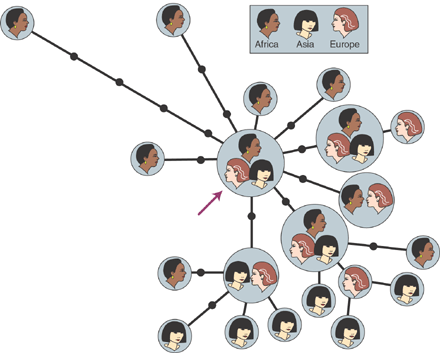
And I found this:


http://www.sciencemag.org/content/291/5507/1219.full?sid=10817772-292e-482c-b589-7b6ef0a77cb5


So here, the biggest circles (containing 3 heads) represent 3 different continents (Africa, Asia and Europe).

The slightly smaller circles (containing 2 heads) represent people from 2 different continents who have identical DNA.

And the smallest circles, (containing 1 head) represent people with DNA from just one continent.


Very nice.  But what does this  mean?

In very simple terms, this means that people from 2 very different continents can have the same or similar DNA.  

This means that all our perceived differences:  the clothes we wear, what language we speak, what religion we follow are all rather arbitrary, shaped by the people and the social world around us.  

This means that we can't just look at a person and really know them.  We can't just look at a person and know that they are truly different from us.  

For all we know, deep in the building blocks that make us up, we might have the same DNA as that person we hold in contempt, that person we are fighting, that person we hate.  

I don't have the scientific evidence  to prove that every human on earth is my cousin.  I don't have the scientific evidence to prove that every human is 99.9% identical to me.   

But I have a heart,  and my heart tells me that we are far more alike than we are different. This holiday season as I read yet another news story about people hating and hurting each other, I can't help but feel that when we hurt and hate  anyone, we are in many ways hurting and hating  ourselves.   

Perhaps someday we'll realize this.  

Until next time.  


Saturday, December 13, 2014

Perspective

In true teacher form, I vanished from my blog just before Halloween and have not appeared until just now, two days after my school went on winter break.  And for this I apologize.

However,  you can probably expect me to vanish again somewhere in early spring as I am writing reports and doing conferences.  You have been warned.


So this morning I was standing at the kitchen sink making coffee, shivering in the icy air, watching my breath billow into clouds of steam.  As I poured my electrically-boiled water into my coffee grounds that were shipped from Brazil to Japan,  griping to myself about uninsulated houses, I realized something.

A huge number of us are pretty much spoiled.
Spoiled rotten I say.
Absolutely, distressingly, alarmingly indulged.

I am spoiled.  You are spoiled.  In fact, anyone able to read this right now is spoiled.

We are spoiled by the conveniences  that we have come to expect as things we deserve, if not MUST HAVE.  

Conveniences.

Such as:

1. Being instantly warm when it is cold.  For thousands and thousands of years humans did not have electric blankets, insulated homes, central heating, electric heating, gas heating.

What they did have was fire, clothing hand-made from animal pelts, wool or hair.  And they had each other to huddle against in shelters that might have blocked the wind and wet, but did not protect them from the cold.

And in fact, right now, as we stand on the brink of 2015, there are many people who still live like this. And these people live far away from us and they live right around the corner.

2. Being instantly cool when it is hot.  Conversely, for thousands and thousands of years, humans living in hot climates or living in the middle of the summer heat did not have electric fans or air conditioners.

What they did have was the hope for a breeze,  shade, and perhaps if they were very lucky an ocean, river, lake, pond or puddle in which to cool off and stay hydrated.

And in fact, right now, as we stand on the brink of 2015, there are many people who still live like this.  And these people live far away from us and they live right around the corner.

3. Having food and drink instantly accessible when we are hungry and thirsty.  Among the most important driving forces of life on this planet, the quest for food and sustenance is one of the most powerful.  Like any other creature, humans have had to gather, scavenge and hunt for food,  dependent on the whims of weather and chance.

And it is all too easy for many of us--living amid the luxuries of supermarkets and refrigeration and a world so tightly connected that I can stand in my Kyoto kitchen making Brazilian coffee--to feel like we deserve to have food and drink at our fingertips.   And not just any food or drink, but EXACTLY the food and drink we have dreamt up.

In fact, right now, as we stand on the brink of 2015, there are many people who are on the brink of starvation, suffering from the diseases that follow famine.  And these people live far away from us and they live right around the corner.


The list goes on...

--having access to clean water and safe, sanitary means of getting rid of our garbage and bodily wastes.

--having access to doctors, nurses, hospitals and medicines when our bodies or minds are sick

--having access to an education that prepares us to be thoughtful, hopeful, participating members of our society and world

--feeling safe in our homes and communities


All of these things and more are modern, "first world" luxuries my friends.  

And sometimes I have to take a big step back and wonder how it is that I can be sitting in front of this computer, able to stretch my useless words across the world at a tap of my finger when millions of people in the world lack food, clean water and life-giving medicines.

How can this computer exist and function in the same world where children are dying from preventable diseases?   How can I be using the power of the internet in the same world where somewhere not far from me a homeless person is huddled, freezing, hiding beneath a bridge over which the tourists and taxicabs and suited business folk race?

It is a strange, troubling world sometimes my friends.  And sometimes we need to take a step back and realize how very unfairly lucky so many of us are.

Until next time...


Saturday, October 25, 2014

So Easy to Fault, So Hard to Fix


Hello all,

Well, the news isn't good.

I could pretend the news IS good, of course.  I could tell you about the wacky, hilarious things my students do and say.  Or I could wax poetic about the beauty of Kyoto in the autumn.

But I can't do that.  Because although I am thousands of miles away from all this, it would be irresponsible to pretend that the world is fine just because my immediate world is fine.


On Friday, October 24th, there was yet another school shooting.  This time in Washington, just north of Seattle at a high school.

The victims and the shooter were all teenagers, 14 and 15 year olds.  The same age as Aya.  Not all that much younger than Patrick.

Already the news agencies are dithering about fault.

The shooter was just a bad kid.

It must have been his parent's fault for not 'raising him right'.

It must have been the school's fault for not being more 'vigilant about security'.


And, as always, hot on the heels of the news agencies, talking internet heads and magazine covers (the covers only, because everyone seems willing to spare a glance, but not spare 5 minutes to read), comes public opinion.

Predictably, the comments on the news websites follow the same lines as the news agencies, agreeing, disagreeing, cursing and insulting or just being trolls, making inflammatory comments and then slipping out of the comment stream to watch their mischief boil.

So whose fault is it?

I would suggest this is a pointless question.  Fault can all too easily be assigned and people who are just as good and flawed and confused about all this as the rest of us can be held out as examples of bad teaching or bad parenting or bad kids.

I would suggest that a better question would be how can we fix this?  

Implied in my question is the emphatic WE.   Because if we have to assign fault, this is our fault too.  As a society.  As fellow human beings.  

For something like this to happen, not just once but many times implies that something is broken.

And many things are broken, not just in the United States but everywhere to varying degrees, in various areas and with various heartbreaking results.

Families are broken, shattered apart by distance and the demands of jobs and social expectation.   Sisters and brothers, cousins and grandparents turn away from each other because our society teaches and supports fragmentation and separation rather than tolerance and empathy.

Schools are broken, steering dedicated, enthusiastic teachers into test-driven curricula seemingly laser focused not to produce thoughtful, empathetic, curious and engaged members of society,  but to produce non-confrontational drones  who just want to survive the demands of school or work until they can live their "real lives".   And the schools that have leapt out of this broken mold are too few and far between, and often too inaccessible financially, to kickstart the kind of change we need.

Society is broken when lethal weapons can be accessed by a teenager who saw himself as having no other outlet for his pain but to strike out.


Imbedded in all this are deeper issues and needs--recognizing that pain of all kinds is an unavoidable part of all our lives, re-educating ourselves and our children and teens that seeking help and support is not a weakness, but a strength, breaking down the pervasive and often damaging gender and social expectations that are so prevalent  and powerful in teenage lives.

I've painted a pretty dismal picture.  But we can repaint the picture.

We can fix this.  

Not immediately to be sure.  But the systematic problems can be addressed.  Schools can be overhauled.   Learning can be redefined for the future we are approaching, rather than swirling in a past we left behind long ago.   Leaders, from government officials to school administrators, from teachers to parents, can re-educate themselves so that we can support our children and teens based on their real needs, and not on our prejudices, phobias and assumptions.

We can fix this.  


The skeptics and pessimists among us would see no point in me even writing about this.   As one commenter said "If nothing changed after Sandy Hook, then nothing will ever change."   And the pessimist in me agrees to a point--change never comes quickly.  People, it seems, have to keep getting hit over the head with deeper truths before they acknowledge that something is broken.

But this is no reason to stop trying.  

And so, I  try in the only way I can.  I write.

Until next time....


Wednesday, September 17, 2014

Rainbow....

White light
is nature's illusionist.

It seems so simple--just light.

But it's not.

Send a sunbeam into a prism
or a water droplet
or perhaps a tear

and it shatters into a hidden spectrum.

A paintbox so cleverly concealed
in our everyday illumination.

If so much convoluted beauty
can hide within the simplicity of light

How many more wonders are invisible
to our everyday eyes?