Hello 2016.
I am writing a message to you, as I did to your predecessor, 2015.
I have to admit that when I wrote to 2015, I was highly skeptical that it would manage to fix the looming messes in which it was instantly embroiled. However, I gave 2015 the benefit of the doubt and in some ways it did live up to its potential.
In other ways, of course, it fell flat on its face in horrifyingly spectacular ways that hinted sharply of some sort of human armageddon.
I have known you, 2016, for about a week now, and I'm afraid that you are starting off at even more of a disadvantage than 2015.
Yet it would seem that you are at a crossroads 2016. You have in front of you 2 choices--care or apathy.
Care about the condition of this planet, or go along with the status quo and keep on truckin' until we all live (and die) in a poisoned morass of filth and illness.
Care about equality and respect between peoples or stand by and watch as we slowly whittle ourselves into extinction.
Care about making the right choices--the choices on the sides of peace and communication and joy and enlightened thought and learning, or lay back and let the ignorance roll on in.
It is up to you. Sadly, your path to making a final choice may be ultimately in your hands. I am sorry that we have dropped this monumental responsibility into your lap.
It would seem that much of humanity can't be trusted to have nice things. Yet.
I'm going to keep that "yet" right there.
After all, 2016, I'm an idealist at heart. And I'm not quite ready to give up on us.
I wish you the best of luck.
Christina
Friday, January 8, 2016

Monday, December 7, 2015
Teachers aren't fooled
Let me paint you a picture.
A teacher with 20 or more years of experience enters a classroom. It could be a classroom of any age really, but let's just say it is a 2nd grade classroom.
The teacher places fingers to door handle and can feel the vibrations of the chaos within.
(S)he opens the classroom door to
mayhem.
Cross-classroom games of catch are being played with stray or snatched hats and shoes. A number of students are huddled against one wall playing a loud game of Pokemon cards. More than a few have pulled out hand held gaming devices, ipads, ipods or iphones. In far corners are the escapees--the thinkers, the readers, artists, writers, dreamers, unperturbed by the squalor. Several varieties of roughhousing are going on. Chairs lay on their sides. Food wrappers and crumbs litter the floor.
In the center of this is the defeated teacher, undoubtedly trying not to cry as (s)he helplessly tries to restore order.
Teachers will recognize this scene. Experienced teachers will recognize walking into a classroom like this, and feeling the blinding empathy for the desperate colleague in the center. And all teachers will recognize the sensation of losing control of a class, even for a moment--most likely from their first few years of teaching, although in truth, it can happen any time, and with incredible speed.
I have been back in the United States for almost 6 months now. When I left for Japan in 2011, the United States was a troubled place, but there was hope. Now it is 2015 and I have returned to the national equivalent of the classroom I just described above.
Other countries are the experienced teachers, standing at the door, empathizing with us but hesitating to do more than watch because they know that the idea of needing to be saved only works in tired fairy tales....and it would most likely damage our delicate American pride.
So they watch from afar as we shoot each other and slowly drown in our own fear and contradictions and confusion. And the noise that can be heard from outside the door? That's the tumult of our ignorance and hate--for ignorance and hate are always louder than reason and peace.
Yet the reason and peace ARE here. There are peaceful, logical, thoughtful people everywhere being drowned out by the loudest, the most poisonous, the wealthiest, the most ignorant and most powerful.
Perhaps it is time for those of us in the corners--the thinkers, the readers, the artists, the writers, the dreamers--to make a little noise of our own.
Sunday, October 25, 2015
Missives to Myself: Dear Head
Dear Head,
Yes, I am talking to you Head. My head.
I just wanted to keep in touch, let you know that the cognitive, imaginative, cerebral me is keeping tabs on the physical me.
I'd like to thank you, Head, for your continuing skill at balancing all your improbable brain weight on my spindly little stalk of a neck. I consider it a true miracle that heads can continue this daily balancing act, so thank you for not falling off.
I'd also like to thank you for your continuing work at keeping things on a nice equilibrium up there. The headaches have been few. I notice the teeth are doing well also. And you've kept the wrinkles to a minimum, which I do appreciate.
I do have a few things to discuss.
First, I notice you've been clenching your jaw in your sleep. This results in me waking up with all sorts of neck tension and I've been told by 2 dentists that I am slowly grinding my tooth enamel away. If you don't mind, please stop your nocturnal jaw and tooth machinations. Thanks.
Second, I notice that you've started some redecorating up in the hair. To be precise, I notice you've started adding a few not-brown hairs. I have already received some gentle mockery about this. In spite of the teasing however, I do not plan on altering your redecorating plans in the foreseeable future. If you do plan to continue adding these white/silver hairs, please do so in a pleasing design, perhaps to create a dramatic streak of white in one section.
I'm planning on taking a short trip down to the feet next week. They've been kind of letting themselves go lately and I'd like to encourage them to invest in some nail care and moisturizer. You know how feet can be.
Oh, and if you visit the knees, please remind them that cold weather is on its way. You know how they hate the cold. Personally, I think it is their own fault for sitting criss-cross all those years and just letting the bursitis set in. Alas, the knees never were ones for thinking ahead.
Have a good week.
Best wishes
Christina
PS--I noticed lately that the eyes are not seeing things as sharply as they could. You might want to take them to the eye doctor soon. Just a friendly reminder.
Yes, I am talking to you Head. My head.
I just wanted to keep in touch, let you know that the cognitive, imaginative, cerebral me is keeping tabs on the physical me.
I'd like to thank you, Head, for your continuing skill at balancing all your improbable brain weight on my spindly little stalk of a neck. I consider it a true miracle that heads can continue this daily balancing act, so thank you for not falling off.
I'd also like to thank you for your continuing work at keeping things on a nice equilibrium up there. The headaches have been few. I notice the teeth are doing well also. And you've kept the wrinkles to a minimum, which I do appreciate.
I do have a few things to discuss.
First, I notice you've been clenching your jaw in your sleep. This results in me waking up with all sorts of neck tension and I've been told by 2 dentists that I am slowly grinding my tooth enamel away. If you don't mind, please stop your nocturnal jaw and tooth machinations. Thanks.
Second, I notice that you've started some redecorating up in the hair. To be precise, I notice you've started adding a few not-brown hairs. I have already received some gentle mockery about this. In spite of the teasing however, I do not plan on altering your redecorating plans in the foreseeable future. If you do plan to continue adding these white/silver hairs, please do so in a pleasing design, perhaps to create a dramatic streak of white in one section.
I'm planning on taking a short trip down to the feet next week. They've been kind of letting themselves go lately and I'd like to encourage them to invest in some nail care and moisturizer. You know how feet can be.
Oh, and if you visit the knees, please remind them that cold weather is on its way. You know how they hate the cold. Personally, I think it is their own fault for sitting criss-cross all those years and just letting the bursitis set in. Alas, the knees never were ones for thinking ahead.
Have a good week.
Best wishes
Christina
PS--I noticed lately that the eyes are not seeing things as sharply as they could. You might want to take them to the eye doctor soon. Just a friendly reminder.
Saturday, October 10, 2015
Once Upon a Library
Buildings have lives.
Did you know?
They may not be alive in the scientific sense, but I do believe that buildings can possess a life, gleaned from the generations of people who use them.
In Japan I always felt a kind of breathless wonder when I stood in front of or inside the temples and shrines that often predated my country of birth by hundreds and hundreds of years. I imagined the people who had once stood where I was, looking at what I was seeing.
The short, mortal lives of humans prevent us from truly touching the lives of those who came far before us, but what humans leave behind--buildings and structures of where we worked and lived--might be the next best thing.
After Japan, nearly all the buildings dubbed "historic" here in the United States are almost laughably young. And after living in Kyoto where we were able to eat soba in a 1000 year old restaurant, a building erected in 1850 doesn't seem all that old.
However, it is not all about the age of the building of course, but about what happened inside that building.
For example.
My friend Sue, like us transplanted to Illinois from Japan and, like me, besotted with books, took me recently on a quest to visit several libraries in small, nearby towns.
Around lunchtime we stopped in Aurora, Il, where she brought me to the front doors of a closed library building. The dignified black marble sign outside clearly said "Aurora Public Library", but its doors were locked, and the tall windows were covered in dust.

It turns out that the Aurora Public Library had outgrown its home, and had been moved 3 blocks away into a gleaming new state-of-the-art building.

And, what's more, it was going to sell off all of the furniture inside the former building that was deemed too old to be moved to the shiny, new building.
So this morning I got up early and drove back to Aurora by myself. This fall morning was as if it were programmed into perfection--clear blue sky, slight chill to the air, bright sunshine. As I drove up and parked the car, the old library building seemed almost pensive. It rested, quiet and heavy, on its bit of land overlooking the Fox River.
A smiling librarian opened the doors promptly at 9am, her fingers deftly twisting the keys in the lock with a familiarity that bespoke her years working in this building. I and a handful of fellow early birds wandered through the doors.
Now, I know not everyone loves books and libraries as I do. But I think most people--even those not enamored of books--would've sensed the wrongness of the empty space.
No books.
No paintings on the walls.
No murmurs of patrons or chatter of children drifting up from the Children's Area. No sound of footsteps on the marble stairs.
The quiet was too quiet even for a library.

I pondered the massiveness of the bookshelves, the heavy wooden study desks, the jumble of sturdy wooden chairs. Without books or people everything seemed unnaturally large and terribly lost.

Perhaps what I disliked most were the massive counters that stood at the entrance to every floor--tall, marble topped counters behind which librarians used to sit, answering questions, directing patrons, checking out books.


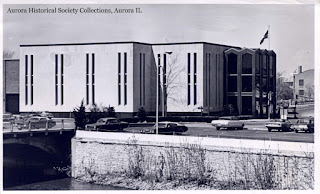
A brick and marble, Carnegie-funded beauty of a building that had originally opened in 1904. However it didn't take too long for the library to start outgrowing itself. Annexes were added as needed. Then in 1969 another renovation happened, resulting in a rather surprising face-lift:
My curiosity satisfied, I explored the library from the top floor to the basement. I knew that most of the furniture I passed would likely end up in a landfill, or, in the case of the metal shelves, torn apart for scrap.
Then I found my piece of this library. In the very corner of the basement, beneath a massive pile of what appeared to be lost-and-found items, I unearthed a single metal library cart made out of welded steel and resting on industrial-strength wheels. It was heavy and ponderous and not terribly lovely, but I knew I had to try to buy it--although considering how much new carts like this cost (upwards of $300 or more), I had a feeling it was temporarily forgotten rather than for sale.
I found a librarian who followed me back down to the basement to assess my find. Along the way she told me about how various rooms had been used, how the floor-to-ceiling metal shelves on the upper floors were not only functional, but actually structural to the building. She pointed out where her office used to be, in a sunshine-filled corner near the front entrance.
We cleared the book cart together and wheeled it to where another librarian was totaling visitor purchases by hand on a paper receipt pad.
"That? 20 bucks. How's that?" She winked at me.
I said "That's perfect. I'll take it."
After adding a Van Gogh framed reproduction oil painting ($5) and a stray chalkboard ($5), I wrote a check for a total of $30 and wheeled my cart out to my car.
The librarians I spoke to today kept saying how they hoped someone would buy the old building and keep it alive. The librarian who totaled my purchases shrugged her shoulders and said,
"This building has no fire suppression and a lot of structural challenges for anyone who wants to renovate it. Still, we hope someone will see what we see in it."
I plan to drive by the old library now and then. I, too hope to one day see the doors open and people inside bustling about.
Keeping it alive.

Did you know?
They may not be alive in the scientific sense, but I do believe that buildings can possess a life, gleaned from the generations of people who use them.
In Japan I always felt a kind of breathless wonder when I stood in front of or inside the temples and shrines that often predated my country of birth by hundreds and hundreds of years. I imagined the people who had once stood where I was, looking at what I was seeing.
The short, mortal lives of humans prevent us from truly touching the lives of those who came far before us, but what humans leave behind--buildings and structures of where we worked and lived--might be the next best thing.
After Japan, nearly all the buildings dubbed "historic" here in the United States are almost laughably young. And after living in Kyoto where we were able to eat soba in a 1000 year old restaurant, a building erected in 1850 doesn't seem all that old.
However, it is not all about the age of the building of course, but about what happened inside that building.
For example.
My friend Sue, like us transplanted to Illinois from Japan and, like me, besotted with books, took me recently on a quest to visit several libraries in small, nearby towns.
Around lunchtime we stopped in Aurora, Il, where she brought me to the front doors of a closed library building. The dignified black marble sign outside clearly said "Aurora Public Library", but its doors were locked, and the tall windows were covered in dust.

It turns out that the Aurora Public Library had outgrown its home, and had been moved 3 blocks away into a gleaming new state-of-the-art building.

So this morning I got up early and drove back to Aurora by myself. This fall morning was as if it were programmed into perfection--clear blue sky, slight chill to the air, bright sunshine. As I drove up and parked the car, the old library building seemed almost pensive. It rested, quiet and heavy, on its bit of land overlooking the Fox River.
A smiling librarian opened the doors promptly at 9am, her fingers deftly twisting the keys in the lock with a familiarity that bespoke her years working in this building. I and a handful of fellow early birds wandered through the doors.
Now, I know not everyone loves books and libraries as I do. But I think most people--even those not enamored of books--would've sensed the wrongness of the empty space.
No books.
No paintings on the walls.
No murmurs of patrons or chatter of children drifting up from the Children's Area. No sound of footsteps on the marble stairs.
The quiet was too quiet even for a library.

I pondered the massiveness of the bookshelves, the heavy wooden study desks, the jumble of sturdy wooden chairs. Without books or people everything seemed unnaturally large and terribly lost.

Perhaps what I disliked most were the massive counters that stood at the entrance to every floor--tall, marble topped counters behind which librarians used to sit, answering questions, directing patrons, checking out books.
I wondered about this library. Outside and inside it seemed fairly modern, while many of the buildings around it were quite old (for the U.S.) A little research on my part revealed this building had grown and changed over the years just as much as any living thing, for beneath its smooth, modern limestone exterior and elegant black windows, it hid what it once was--


A brick and marble, Carnegie-funded beauty of a building that had originally opened in 1904. However it didn't take too long for the library to start outgrowing itself. Annexes were added as needed. Then in 1969 another renovation happened, resulting in a rather surprising face-lift:

My curiosity satisfied, I explored the library from the top floor to the basement. I knew that most of the furniture I passed would likely end up in a landfill, or, in the case of the metal shelves, torn apart for scrap.
Then I found my piece of this library. In the very corner of the basement, beneath a massive pile of what appeared to be lost-and-found items, I unearthed a single metal library cart made out of welded steel and resting on industrial-strength wheels. It was heavy and ponderous and not terribly lovely, but I knew I had to try to buy it--although considering how much new carts like this cost (upwards of $300 or more), I had a feeling it was temporarily forgotten rather than for sale.
I found a librarian who followed me back down to the basement to assess my find. Along the way she told me about how various rooms had been used, how the floor-to-ceiling metal shelves on the upper floors were not only functional, but actually structural to the building. She pointed out where her office used to be, in a sunshine-filled corner near the front entrance.
We cleared the book cart together and wheeled it to where another librarian was totaling visitor purchases by hand on a paper receipt pad.
"That? 20 bucks. How's that?" She winked at me.
I said "That's perfect. I'll take it."
After adding a Van Gogh framed reproduction oil painting ($5) and a stray chalkboard ($5), I wrote a check for a total of $30 and wheeled my cart out to my car.
The librarians I spoke to today kept saying how they hoped someone would buy the old building and keep it alive. The librarian who totaled my purchases shrugged her shoulders and said,
"This building has no fire suppression and a lot of structural challenges for anyone who wants to renovate it. Still, we hope someone will see what we see in it."
I plan to drive by the old library now and then. I, too hope to one day see the doors open and people inside bustling about.
Keeping it alive.

Sunday, October 4, 2015
One Nation, Many Guns
Dear people,
Dear healthy and sick, exhausted and invigorated, old and young, confident and questioning,
Dear police officers and custodians, bakers and dishwashers,
Dear teachers and firefighters, nurses and doctors, bus drivers and construction workers,
Dear soldiers and engineers, office workers and inventors, writers and gardeners,
Dear dancers and artists, computer wizards and garbage collectors,
Dear rich people and poor people, homeless people and people struggling to stay in the supposed middle-class,
Dear parents and families, spouses and partners, college students, teens and children,
Dear people,
I want to talk about guns.
Guns were created for one purpose. They serve one function.
They are machines made for killing.
In the end,
when we have exhausted making our stubborn arguments and offering our skewed reasons for why guns are good,
in the very end
guns are made to create precise and violent holes in things-
holes that can injure and kill.
The Merriam-Webster Dictionary* defines society like so:
society
noun so·ci·e·ty \sə-ˈsī-ə-tē\ plural so·ci·e·ties
Look at these words...
companionship
association
organized
relationships
enduring
enduring
ENDURING.
Do you want to be patriotic? I can be patriotic. Here is the Pledge of Allegiance**.
In 1892
"I pledge allegiance to my Flag and the Republic for which it stands, one nation, indivisible, with liberty and justice for all."
In 1923
"I pledge allegiance to the Flag of the United States of America and to the Republic for which it stands, one nation, indivisible, with liberty and justice for all."
In 1954
"I pledge allegiance to the flag of the United States of America, and to the republic for which it stands, one nation under God, indivisible, with liberty and justice for all."
In every permutation of the Pledge of Allegiance three words stand out, spoken in every version with precision and focus--one nation, indivisible.
One nation
indivisible.
indivisible
INDIVISIBLE.
Are we indivisible?
Will we endure?
I'm not so sure.
Out of all the things that divide us, the presence and use of guns seems to be the real unsurmountable knife's edge.
Yet, ironically, in the face of all our divisions, guns are the great ignorant, mindless equalizer.
After all, to shoot a gun the only thing you need to be able to do is pull a trigger.
I would beg everyone to consider a society where you need not live in fear of being shot
at school
or on a university campus.
Where you can go to the movies
or your house of worship
without looking over your shoulder.
I have spent many years living overseas in such a society where
my fears never had to include the fear of dying suddenly by an unknown hand.
And I have returned to this country of my birth wondering how close will the next
school
or campus
or other random shooting location
strike in my life? In the lives of those I love?
We live in a country of promise and potential.
Ironically, it is a country where we have become more adept at
tearing each other apart
than building each other up.
We must take the first step towards reaching our potential.
We must make the presence of guns among us the exception rather than the rule.... a device of last resort for those trained and intelligent enough to be trusted, rather than a ubiquitous shoulder shrug of violence.
One nation, No guns.
Only then will we begin to become
enduring
and
indivisible.
Sincerely,
christina
*http://www.merriam-webster.com/dictionary/society
**http://www.ushistory.org/documents/pledge.htm
Dear healthy and sick, exhausted and invigorated, old and young, confident and questioning,
Dear police officers and custodians, bakers and dishwashers,
Dear teachers and firefighters, nurses and doctors, bus drivers and construction workers,
Dear soldiers and engineers, office workers and inventors, writers and gardeners,
Dear dancers and artists, computer wizards and garbage collectors,
Dear rich people and poor people, homeless people and people struggling to stay in the supposed middle-class,
Dear parents and families, spouses and partners, college students, teens and children,
Dear people,
I want to talk about guns.
Guns were created for one purpose. They serve one function.
They are machines made for killing.
In the end,
when we have exhausted making our stubborn arguments and offering our skewed reasons for why guns are good,
in the very end
guns are made to create precise and violent holes in things-
holes that can injure and kill.
Guns are the erasers of futures,
the easy way out vengeance providers,
the ultimate threat with which to reflect and perform
our weaknesses, our fears and our hatred
of everything and everyone in our society and our world that we choose to misunderstand.
The Merriam-Webster Dictionary* defines society like so:
society
noun so·ci·e·ty \sə-ˈsī-ə-tē\ plural so·ci·e·ties
1
: companionship or association with one's fellows : friendly or intimate intercourse
2
: a voluntary association of individuals for common ends; especially : an organized group working together or periodically meeting because of common interests, beliefs, or profession
3
a : an enduring and cooperating social group whose members have developed organized patterns of relationships through interaction with one another
b : a community, nation, or broad grouping of people having common traditions, institutions, and collective activities and interests
4
a : a part of a community that is a unit distinguishable by particular aims or standards of living or conduct : a social circle or a group of social circles having a clearly marked identity
Look at these words...
companionship
association
organized
relationships
enduring
enduring
ENDURING.
Do you want to be patriotic? I can be patriotic. Here is the Pledge of Allegiance**.
In 1892
"I pledge allegiance to my Flag and the Republic for which it stands, one nation, indivisible, with liberty and justice for all."
In 1923
"I pledge allegiance to the Flag of the United States of America and to the Republic for which it stands, one nation, indivisible, with liberty and justice for all."
In 1954
"I pledge allegiance to the flag of the United States of America, and to the republic for which it stands, one nation under God, indivisible, with liberty and justice for all."
In every permutation of the Pledge of Allegiance three words stand out, spoken in every version with precision and focus--one nation, indivisible.
One nation
indivisible.
indivisible
INDIVISIBLE.
Are we indivisible?
Will we endure?
I'm not so sure.
Out of all the things that divide us, the presence and use of guns seems to be the real unsurmountable knife's edge.
Yet, ironically, in the face of all our divisions, guns are the great ignorant, mindless equalizer.
After all, to shoot a gun the only thing you need to be able to do is pull a trigger.
I would beg everyone to consider a society where you need not live in fear of being shot
at school
or on a university campus.
Where you can go to the movies
or your house of worship
without looking over your shoulder.
I have spent many years living overseas in such a society where
my fears never had to include the fear of dying suddenly by an unknown hand.
And I have returned to this country of my birth wondering how close will the next
school
or campus
or other random shooting location
strike in my life? In the lives of those I love?
We live in a country of promise and potential.
Ironically, it is a country where we have become more adept at
tearing each other apart
than building each other up.
We must take the first step towards reaching our potential.
We must make the presence of guns among us the exception rather than the rule.... a device of last resort for those trained and intelligent enough to be trusted, rather than a ubiquitous shoulder shrug of violence.
One nation, No guns.
Only then will we begin to become
enduring
and
indivisible.
Sincerely,
christina
*http://www.merriam-webster.com/dictionary/society
**http://www.ushistory.org/documents/pledge.htm
Thursday, August 6, 2015
August 6th
Today is August 6th.
Under the hot August sun and painfully blue August sky, I had a day full of regular tasks and fun moments and unremarkable concerns.
But on this day in 1945 the hot sun and painfully blue sky cracked open over Hiroshima, Japan...and then again over Nagasaki, Japan.
And Death came down.
I'm not going to engage in arguments about World War II politics and ethics. I'm not writing this to insult, nor am I writing this to provoke. I am not writing this to hold up the horror of one moment in history as worse or better than the horror of so many other moments in human history.
I'm writing this so that we remember.
I've visited Hiroshima. I've gone to the Peace Museum where the flash-shadow of a disintegrated human body was still visible on a brick wall.
I saw the melted bento boxes, the shattered fragments of lives.
And I saw the impossible photos. And I read the bewildered first-hand accounts.
The vibrant, modern city outside the Peace Museum seemed to throw the gently lit remnants of horror into even greater focus.
The museum asked for one thing: peace.
And so I post this for one reason: peace.
And I share this poem for one reason: peace.
As much as I love weaving words, Maya Angelou reflects my feelings best.
And so I shall let her speak for me.
A Brave and Startling Truth
Under the hot August sun and painfully blue August sky, I had a day full of regular tasks and fun moments and unremarkable concerns.
But on this day in 1945 the hot sun and painfully blue sky cracked open over Hiroshima, Japan...and then again over Nagasaki, Japan.
And Death came down.
I'm not going to engage in arguments about World War II politics and ethics. I'm not writing this to insult, nor am I writing this to provoke. I am not writing this to hold up the horror of one moment in history as worse or better than the horror of so many other moments in human history.
I'm writing this so that we remember.
I've visited Hiroshima. I've gone to the Peace Museum where the flash-shadow of a disintegrated human body was still visible on a brick wall.
I saw the melted bento boxes, the shattered fragments of lives.
And I saw the impossible photos. And I read the bewildered first-hand accounts.
The vibrant, modern city outside the Peace Museum seemed to throw the gently lit remnants of horror into even greater focus.
The museum asked for one thing: peace.
And so I post this for one reason: peace.
And I share this poem for one reason: peace.
As much as I love weaving words, Maya Angelou reflects my feelings best.
And so I shall let her speak for me.
A Brave and Startling Truth
We, this people, on a small and lonely planet
Traveling through casual space
Past aloof stars, across the way of indifferent suns
To a destination where all signs tell us
It is possible and imperative that we learn
A brave and startling truth
And when we come to it
To the day of peacemaking
When we release our fingers
From fists of hostility
And allow the pure air to cool our palms
When we come to it
When the curtain falls on the minstrel show of hate
And faces sooted with scorn are scrubbed clean
When battlefields and coliseum
No longer rake our unique and particular sons and daughters
Up with the bruised and bloody grass
To lie in identical plots in foreign soil
When the rapacious storming of the churches
The screaming racket in the temples have ceased
When the pennants are waving gaily
When the banners of the world tremble
Stoutly in the good, clean breeze
When we come to it
When we let the rifles fall from our shoulders
And children dress their dolls in flags of truce
When land mines of death have been removed
And the aged can walk into evenings of peace
When religious ritual is not perfumed
By the incense of burning flesh
And childhood dreams are not kicked awake
By nightmares of abuse
When we come to it
Then we will confess that not the Pyramids
With their stones set in mysterious perfection
Nor the Gardens of Babylon
Hanging as eternal beauty
In our collective memory
Not the Grand Canyon
Kindled into delicious color
By Western sunsets
Nor the Danube, flowing its blue soul into Europe
Not the sacred peak of Mount Fuji
Stretching to the Rising Sun
Neither Father Amazon nor Mother Mississippi who, without favor,
Nurture all creatures in the depths and on the shores
These are not the only wonders of the world
When we come to it
We, this people, on this minuscule and kithless globe
Who reach daily for the bomb, the blade and the dagger
Yet who petition in the dark for tokens of peace
We, this people on this mote of matter
In whose mouths abide cankerous words
Which challenge our very existence
Yet out of those same mouths
Come songs of such exquisite sweetness
That the heart falters in its labor
And the body is quieted into awe
We, this people, on this small and drifting planet
Whose hands can strike with such abandon
That in a twinkling, life is sapped from the living
Yet those same hands can touch with such healing, irresistible tenderness
That the haughty neck is happy to bow
And the proud back is glad to bend
Out of such chaos, of such contradiction
We learn that we are neither devils nor divines
When we come to it
We, this people, on this wayward, floating body
Created on this earth, of this earth
Have the power to fashion for this earth
A climate where every man and every woman
Can live freely without sanctimonious piety
Without crippling fear
When we come to it
We must confess that we are the possible
We are the miraculous, the true wonder of this world
That is when, and only when
We come to it.
Traveling through casual space
Past aloof stars, across the way of indifferent suns
To a destination where all signs tell us
It is possible and imperative that we learn
A brave and startling truth
And when we come to it
To the day of peacemaking
When we release our fingers
From fists of hostility
And allow the pure air to cool our palms
When we come to it
When the curtain falls on the minstrel show of hate
And faces sooted with scorn are scrubbed clean
When battlefields and coliseum
No longer rake our unique and particular sons and daughters
Up with the bruised and bloody grass
To lie in identical plots in foreign soil
When the rapacious storming of the churches
The screaming racket in the temples have ceased
When the pennants are waving gaily
When the banners of the world tremble
Stoutly in the good, clean breeze
When we come to it
When we let the rifles fall from our shoulders
And children dress their dolls in flags of truce
When land mines of death have been removed
And the aged can walk into evenings of peace
When religious ritual is not perfumed
By the incense of burning flesh
And childhood dreams are not kicked awake
By nightmares of abuse
When we come to it
Then we will confess that not the Pyramids
With their stones set in mysterious perfection
Nor the Gardens of Babylon
Hanging as eternal beauty
In our collective memory
Not the Grand Canyon
Kindled into delicious color
By Western sunsets
Nor the Danube, flowing its blue soul into Europe
Not the sacred peak of Mount Fuji
Stretching to the Rising Sun
Neither Father Amazon nor Mother Mississippi who, without favor,
Nurture all creatures in the depths and on the shores
These are not the only wonders of the world
When we come to it
We, this people, on this minuscule and kithless globe
Who reach daily for the bomb, the blade and the dagger
Yet who petition in the dark for tokens of peace
We, this people on this mote of matter
In whose mouths abide cankerous words
Which challenge our very existence
Yet out of those same mouths
Come songs of such exquisite sweetness
That the heart falters in its labor
And the body is quieted into awe
We, this people, on this small and drifting planet
Whose hands can strike with such abandon
That in a twinkling, life is sapped from the living
Yet those same hands can touch with such healing, irresistible tenderness
That the haughty neck is happy to bow
And the proud back is glad to bend
Out of such chaos, of such contradiction
We learn that we are neither devils nor divines
When we come to it
We, this people, on this wayward, floating body
Created on this earth, of this earth
Have the power to fashion for this earth
A climate where every man and every woman
Can live freely without sanctimonious piety
Without crippling fear
When we come to it
We must confess that we are the possible
We are the miraculous, the true wonder of this world
That is when, and only when
We come to it.
Saturday, July 25, 2015
Skin
I have been painting a chair lately.
Here in our echoey new apartment in Glen Ellyn, Illinois, I have been trying to slowly-like-an-exhasuted-snail-slowly find used furniture that either strikes me as particularly quirky, particularly useful or at least particularly inexpensive.
So I have been painting a $5 wooden chair.
And on top of the paint I have been writing my favorite quotes.
On the seat I have painted a picture of a certain coral sand beach that is at this moment further from me than it has ever been before.
Why paint that beach? Because I knew that sometimes I might feel the need to sit on that beach, and since I cannot literally sit on that beach, I can at least figuratively sit on that beach.
And as I was painting this beloved beach onto the seat of this $5 chair, I inevitably got paint on my hands.
I put the lids on my pain bottles and went to the kitchen sink to wash my hands.
Under the cool water and lavender-scented soap, the paint came off easily, peeling out from beneath my finger nails and sloughing off my knuckles.
And I realized just how spectacular and wondrous our skin is.
Our skin keeps our insides from being outsides. It encapsulates everything we are. It renews itself daily, but does so in microscopic bits so that we don't feel the loss. Our skin resists stains, is waterproof and can be easily cleansed of most messes and aromas that would taint other materials. For most of us our skin resists damage and heals itself when it is cut or torn. When we are hot our skin sweats us cool; when we are cold our skin shivers us warm. Our skin endeavors, through its very cells, to protect us from the rays of the sun, the moisture of the rain and the icy pelt of snow.
And it is beautiful. Our skin comes in an array of rich, lovely colors. Our skin adapts to our efforts to adorn it, allowing us to turn it into even more of a work of art than it already is as we pierce or tattoo, henna or self-tan, inject or otherwise alter ourselves into our current identities. And over time, our skin becomes the parchment upon which our life is written, each wrinkle and scar part of the story that is us.
Skin is something we all have. The cells that make up our skin twin with the cells that make up the skin of each person on this earth.
And yet.
It is this same wondrous material--this skin we wear all our lives--that still, STILL inspires hate and mistrust as those ignorant of the power of our skin use it as a weapon.
As the last rubbery bits of paint washed from my hands I marveled how very much alike my skin was to any work of art--the beautiful raw materials at the start slowly, painstakingly transformed into beauty. And just as easily defaced and destroyed.
Here in our echoey new apartment in Glen Ellyn, Illinois, I have been trying to slowly-like-an-exhasuted-snail-slowly find used furniture that either strikes me as particularly quirky, particularly useful or at least particularly inexpensive.
So I have been painting a $5 wooden chair.
And on top of the paint I have been writing my favorite quotes.
On the seat I have painted a picture of a certain coral sand beach that is at this moment further from me than it has ever been before.
Why paint that beach? Because I knew that sometimes I might feel the need to sit on that beach, and since I cannot literally sit on that beach, I can at least figuratively sit on that beach.
And as I was painting this beloved beach onto the seat of this $5 chair, I inevitably got paint on my hands.
I put the lids on my pain bottles and went to the kitchen sink to wash my hands.
Under the cool water and lavender-scented soap, the paint came off easily, peeling out from beneath my finger nails and sloughing off my knuckles.
And I realized just how spectacular and wondrous our skin is.
Our skin keeps our insides from being outsides. It encapsulates everything we are. It renews itself daily, but does so in microscopic bits so that we don't feel the loss. Our skin resists stains, is waterproof and can be easily cleansed of most messes and aromas that would taint other materials. For most of us our skin resists damage and heals itself when it is cut or torn. When we are hot our skin sweats us cool; when we are cold our skin shivers us warm. Our skin endeavors, through its very cells, to protect us from the rays of the sun, the moisture of the rain and the icy pelt of snow.
And it is beautiful. Our skin comes in an array of rich, lovely colors. Our skin adapts to our efforts to adorn it, allowing us to turn it into even more of a work of art than it already is as we pierce or tattoo, henna or self-tan, inject or otherwise alter ourselves into our current identities. And over time, our skin becomes the parchment upon which our life is written, each wrinkle and scar part of the story that is us.
Skin is something we all have. The cells that make up our skin twin with the cells that make up the skin of each person on this earth.
And yet.
It is this same wondrous material--this skin we wear all our lives--that still, STILL inspires hate and mistrust as those ignorant of the power of our skin use it as a weapon.
As the last rubbery bits of paint washed from my hands I marveled how very much alike my skin was to any work of art--the beautiful raw materials at the start slowly, painstakingly transformed into beauty. And just as easily defaced and destroyed.
Subscribe to:
Posts (Atom)